


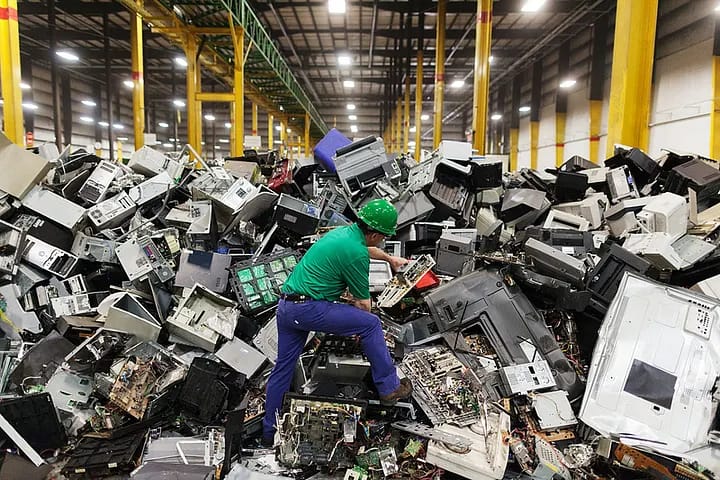
Every year, businesses retire thousands of laptops, servers, and network devices in pursuit of better performance, security, and scalability. But far too much of that technology ends up gathering dust in storage, prematurely scrapped, or worse — dumped in landfills. This isn’t just wasteful — it’s a lost opportunity. For people, for the planet, and for leadership with purpose.
IT and business leaders are uniquely positioned to turn this waste into real impact. With sustainability becoming a core component of corporate strategy, the end-of-life stage for hardware should be treated with as much strategic intent as procurement or deployment. Done right, decommissioned tech can reduce e-waste, bridge digital divides, and move organizations closer to Environmental, Social, and Governance (ESG) goals. Here’s how to take ownership — and why it matters.
The Potential of Old Tech
Imagine a company of 10,000 employees doing standard refreshes every four years. That’s 2,500 devices per year. Even if only half are viable for reuse, that’s 1,250 refurbished laptops that could reach schools, nonprofits, seniors’ homes, small businesses, or new Canadians — often enabling first-time access to essential technology.
Over a decade, that’s 12,500 lives potentially transformed through education, health services, employment, or entrepreneurship. But this kind of impact doesn’t happen by accident. It takes strategy, process, and commitment.
The Problem: No Plan for Old Tech
Many organizations have strong processes for on-boarding new technology — but no clear path for off-boarding. Common issues include:
- Warehouse Graveyards: Retired devices sit idle, incurring storage costs with no ROI.
- Premature Disposal: Still-functional hardware is written off or sold for pennies on the dollar.
- Recycling Without Purpose: Equipment goes straight to recyclers, skipping assessment for reuse.
These outcomes are often driven by concerns around data security, convenience, or perceived cost. But the reality is: failure to plan is failure to lead. When speed replaces strategy, both social value and environmental responsibility are lost.
A Practical Solution: Refurbish and Repurpose
Business-grade laptops — even those five to six years old — often still run modern operating systems, including Windows 10/11 or mainstream Linux distributions like Ubuntu or Fedora. These devices are still highly effective for:
- Students in underserved communities
- Nonprofit training programs or job centers
- Seniors needing digital access for health and social connection
- Rural clinics managing digital records
- Newcomers and entrepreneurs building their first business
One donated laptop can help a student access online learning, a senior manage prescriptions through telehealth, or a new Canadian launch a career. Partnering with responsible recyclers ensures only viable devices are reused and others are safely recycled.
The Bigger Picture: People and Planet
This isn’t just about donating laptops — it’s about building equity and sustainability into IT strategy.
Human Impact
A refurbished device can create real-world outcomes:
- Students: Access to digital classrooms and remote learning
- Seniors: Social connection and health management tools
- Entrepreneurs: Digital platforms to launch and grow businesses
- Healthcare Workers: Tools for basic record-keeping in remote settings
- Refugees & Newcomers: Support for integration, job applications, and language training
Environmental Impact
E-waste is the fastest-growing waste stream on the planet. By 2025, it’s expected to reach 62 million metric tons — up from 54 million in 2019. A single laptop can require 300–400 kg of CO₂ to manufacture. That’s the same as driving a gasoline car 1,000 miles.
Refurbishing 1,000 laptops instead of buying new could save an estimated 350 metric tons of CO₂ — roughly the equivalent of removing 75 cars from the road for a year.
How Tech Leaders Can Act
Leadership is about action. Responsible off-boarding doesn’t require massive investment — just intention and a framework.
1. Plan for End-of-Life from Day One
- Bake hardware off-boarding into your IT lifecycle policies
- Use secure, NIST 800–88–compliant data erasure tools (e.g., DBAN, Blancco) for approximately $5–$10 per device; some electronics recyclers also offer this service as part of their disposal process
- In Canada, explore tax benefits for donations through CRA’s gifts of property provisions; in the US, leverage IRS Section 170 deductions
2. Partner with Purpose
Choose organizations that understand the intersection of security, reuse, and community impact:
- In Canada: Partner with groups like ERA (Electronic Recycling Association), Computers for Schools Plus, or TechReset
- In the US: Consider TechSoup, PCs for People, or Digitunity
- Both countries: Look to regional colleges, Indigenous communities, libraries, and newcomer support centers to start local
3. Track and Share Impact
Make the business case visible and measurable:
- Track devices donated, CO₂ saved, and recipients reached
- Incorporate results into ESG and CSR reporting
- Share human-impact stories — whether it’s a student winning a scholarship or a senior reconnecting with family
- Use LinkedIn, internal communications, and annual reports to highlight your organization’s leadership
4. Engage Employees
Sustainability starts with culture. Involve your people:
- Run workshops or lunch-and-learns on the environmental and social value of e-waste reduction
- Launch employee-led clean-up drives or volunteer refurbishing days
- Take a cue from Google’s “Tech Giveback” program — where employees help refurbish donated equipment for local schools
Overcoming Common Barriers
Yes, challenges exist — but so do practical solutions:
- Data Security: Use certified data destruction methods and secure chain-of-custody
- Cost: Refurbishment is often cheaper than recycling and can offer tax offsets
- Logistics: Start with hyperlocal distribution to simplify transport and reduce costs
- Device Viability: Pre-screen equipment with refurb partners — send only usable hardware forward
The Ripple Effect
Donating 1,250 laptops per year might seem like a drop in the bucket — but over a decade, it’s 12,500 people reached. Education, employment, digital access — this is infrastructure for opportunity.
Even if some devices fail post-refurbishment, the effort still matters. Progress beats perfection. Every successful donation creates value where none existed before.
A Call to Action for Tech and Business Leaders
A tech refresh shouldn’t mark the end of a device’s usefulness — it should be the beginning of its second life. If you’re leading IT, infrastructure, or sustainability, make device off-boarding part of your strategy. Align it with your ESG goals. Partner with purpose. Involve your teams.
Don’t let e-waste become a liability. Turn it into legacy.
Insights, strategy, and forward-thinking IT solutions.
Visit https://www.vyings.com